Automated Manager
Recorded activity becomes priorities, cost reviews and decisions. Evidence, calculations and explicit assumptions stay attached to the recommendation.
Building an operating ecosystem for small F&B businesses.
Daily records are the starting point, not the end product. INDOWYSS connects an automated Manager, receipt-based promotion and coordinated purchasing around the same business operations.
01 / The product
Screens captured from the application during local QA. UI labels are in Indonesian; the descriptions below explain the purpose in English. These are not customer revenue or rollout results.
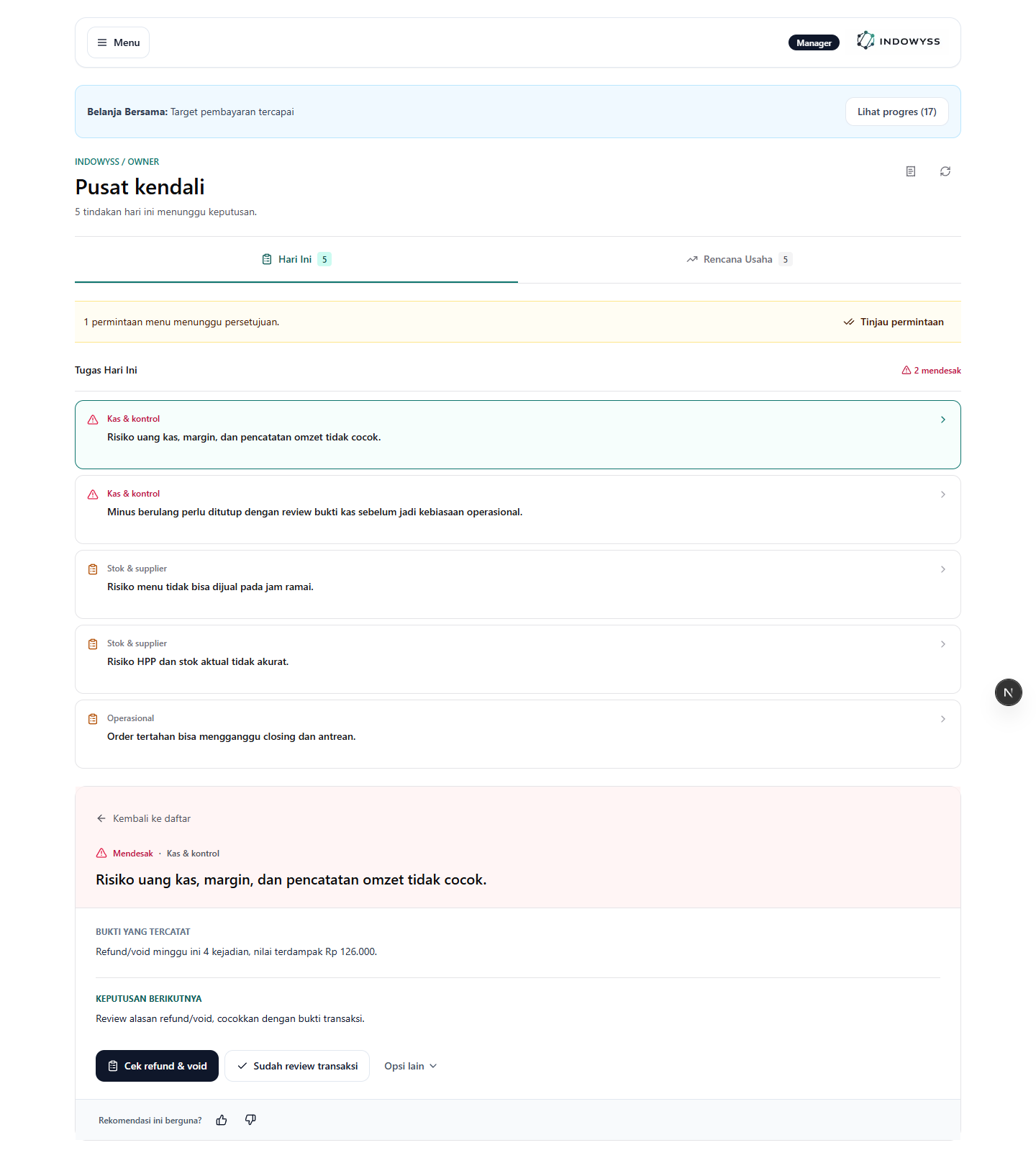
Automated Manager
Daily issues and longer-term business plans have separate places. Each decision can show its recorded evidence and open the relevant operational workflow.
Recorded activity becomes priorities, cost reviews and decisions. Evidence, calculations and explicit assumptions stay attached to the recommendation.
A participating outlet's promotion appears on another outlet's customer receipt. Owners control the offer and its conditions.
Compatible needs meet supplier offers and minimum quantities. Buyers review quality, price and fulfilment terms before a final commitment.
Transactions, receipts, shifts, expenses, closing, stock and menu costs provide the records that make the ecosystem useful.
02 / Management thinking
The Manager follows a practical sequence: recorded evidence, a calculation or scenario when needed, then a next action. Missing costs limit the conclusion instead of being filled in with invented figures.
Record the purchase and review the affected menu-cost basis.
Calculate the effect using known costs, sales and stated assumptions.
Price changes and other consequential actions require authorised approval.
Compare later records with the earlier period; do not treat correlation as proof.
Staffing and equipment scenarios compare additional sales contribution with additional costs. Equipment payback is conditional on the assumed benefit actually occurring.
Before-and-after reviews keep menu costs and extra trial costs visible. A better period is not automatically net profit or proof that one action caused the improvement.
03 / The business network
A customer who shops at outlet A can see a promotion from participating outlet B on the receipt. Outlet B sets the terms and the customer follows the claim path. Visibility is an opportunity, not a promise of conversion.
Payment, refund and settlement states are modelled through sandbox and partner-adapter boundaries. Production money movement is a separate activation step.
04 / INDOWYSS OS & AI design
The OS approach defines how records should become trustworthy context, decisions and follow-up. Current Manager calculations and rules work from operational records; external AI is not the source of financial truth.
Transactions, closing, purchases and costs.
Inputs, permissions and outlet scope.
Completeness and usable evidence.
Backend figures and explicit assumptions.
Evidence, impact and a next action.
Human approval, feedback and later records.
AI helps explain; the backend calculates; the owner decides. Structured outlet context and outcome records can strengthen subsequent analysis. They do not mean an external model automatically retrains itself or that every product feature already uses one unified OS pipeline.
05 / Quality & delivery
Validation work has included unit checks, real local PostgreSQL/API testing, production builds and browser QA across desktop and mobile. These describe development practice, not a claim that all public-production risks are resolved.
Review transactions arriving around shift closure and server-side financial totals.
Check duplicate requests, stock return and already-refunded or voided records.
Keep closing independent of immediate queue availability and preserve follow-up work.
Scope records by outlet and require the appropriate role for consequential changes.
06 / My contribution
I am Wisnu Falah, the independent founder and product builder behind INDOWYSS. The project started with manual records and AI-assisted analysis for small F&B operators in Batam in 2025, then evolved into a structured software product.
Development stack used TypeScript · Next.js · NestJS · PostgreSQL · Prisma · Git
Practical background Family retail operations · Part-time F&B service · Sales · English teaching
This is a product-development portfolio, not previously held hotel departmental-management employment. Private source code, credentials and customer records are excluded.
Documents & contact