Evidence before advice
Recorded cash differences, stock pressure and cost changes support the report. A cash difference is not automatically theft; delayed orders are not automatically lost sales.
One operating ecosystem.
Four connected advantages.
A business should get more from its daily records than another dashboard. INDOWYSS connects an automated Manager, shared promotion, collective purchasing and modern operations so owners can understand what is happening, decide what to do and work with other businesses.
01 / The ecosystem
Transactions, costs and purchases create the operating record. The Manager uses that record; Cross Promo creates a route to other customers; purchasing connects compatible needs with supplier offers. The value is in the connection.
01 / Automated Manager
The Manager is an automated system, not a person replacing the owner. Hari Ini separates immediate work from Rencana Usaha, where the owner can review changes to prices, staffing or equipment.

Owner control
Daily tasks and business plans have separate places. Evidence stays attached to the decision, with a route back to the operational record.
Recorded cash differences, stock pressure and cost changes support the report. A cash difference is not automatically theft; delayed orders are not automatically lost sales.
Use recorded menu costs and your own estimates to compare extra sales contribution with staff or equipment costs. The result is conditional, not a promise of profit.
Record a trial and compare later operating records. A better period is evidence to review, not proof that a single action caused the improvement.
Web: evidence → calculation or scenario when needed → decision. Technical detail and assumptions stay available without overwhelming the summary.
WhatsApp: a short, actionable summary only when attention is needed, subject to consent, channel availability and repeat-message controls.
Real WhatsApp delivery and paid external AI are not active in the demonstrated environment. The current Manager already uses backend calculations and coded rules.
02 / Cross Promo
Owners choose the promotion and its conditions. The offer appears on receipts from participating outlets, with the destination and a claim path. It is shared customer reach, not a promise that every recipient will visit.
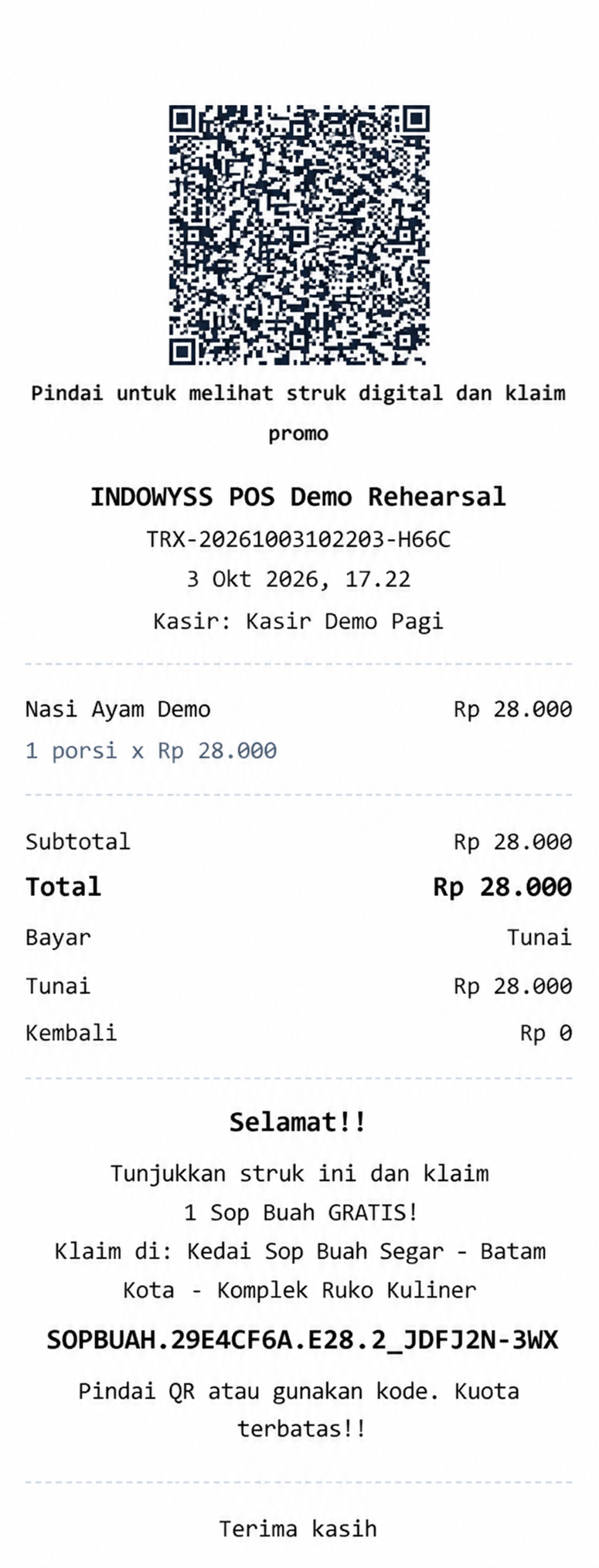
From one purchase to a new introduction
An ordinary sale creates a receipt.
For example, a free fruit soup under B's chosen terms.
The destination, conditions and voucher/QR give the offer a concrete next step.
The network is the product value. An outlet can introduce itself beyond its own existing customers. Conversion and repeat visits still need to be measured.
03 / Collective purchasing & suppliers
An outlet chooses its own quantity. Compatible needs are combined by item, specification, area and fulfilment terms. Suppliers can contribute offers; buyers decide only after seeing the final terms.
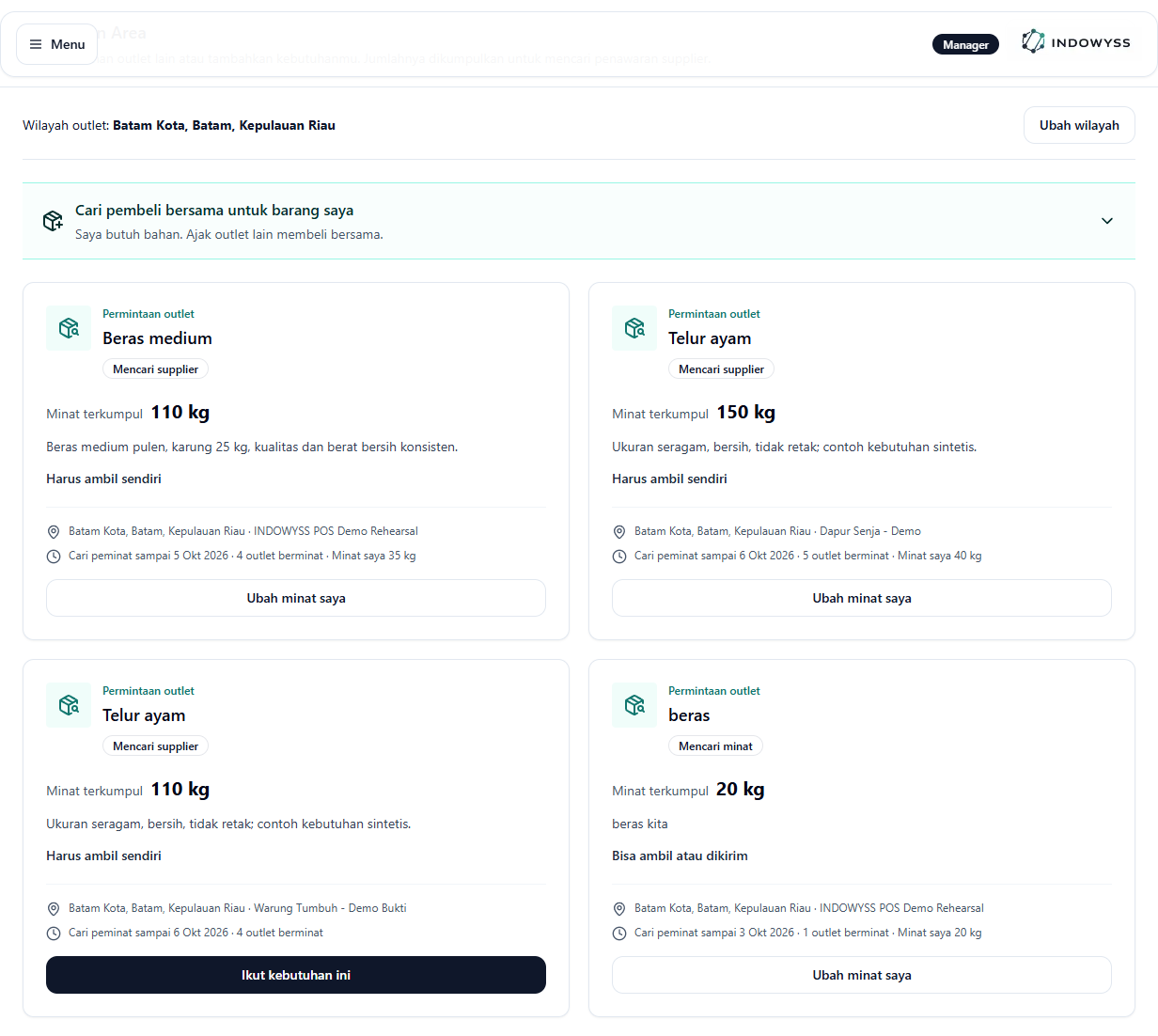
Outlet needs
Each need shows an item, area, specification and quantity. Posting interest does not create a payment obligation.
Buyers track interest, orders, progress and history. Suppliers review stock confirmation, offers and preparation work. Demand and a final order remain different records.
A buyer requesting delivery is not silently matched to pickup-only fulfilment. Price, location, schedule, costs and fulfilment need explicit agreement.
The implemented model separates goods value, buyer fee, supplier deduction and partner charges. New agreements use a 0.5% buyer fee and 0.5% supplier fee; previous accepted terms are preserved.
Under this model, the platform fee is earned on received goods. Failed payment-MOQ rounds refund the paid amount, including the buyer fee. These are tested sandbox rules, not a claim of active money movement.
Production payment, refund and payout require partner activation and real end-to-end verification. Bank/payment-partner charges are separate.
04 / Modern operations
Browser-based transactions, receipts, shifts, expenses, closing, stock and menu costs form the foundation. The goal is practical daily work on a phone, tablet or computer, with no app download.

Restaurant Beta
Tables, orders and kitchen/billing states build on the existing POS record in an isolated beta lane.
Owner decisions and staff operations have different permissions. Sensitive price, stock, refund and financial changes require the authorised role.
Menu costs can separate ingredients, direct costs and allocated overhead. Missing cost coverage limits the conclusion; revenue is not labelled net profit.
Local tests cover repeated refunds, concurrent closing, sync retries and queue failure. Those tests support delivery discipline, not a blanket production guarantee.
02 / INDOWYSS OS & AI
The OS direction is broader than a cash register: a common discipline for data quality, calculations, decisions, permissions and follow-up across sources and business types. The current Manager is grounded in POS records; the universal multi-source path is still being developed.
Transactions, closing, purchases, costs and authorised operational inputs.
Check inputs, ownership, units, time and duplicate records.
Use available history and expose missing or weak data.
Backend calculations produce figures and explicit assumptions.
Rules select attention and actions; AI can assist with explanation.
The owner approves important actions, then reviews later records.
Backend calculates. AI helps explain. The owner decides. An AI model must not invent costs, savings or investment returns. It must not change prices, issue refunds or move money on its own.
Longer outlet history, more complete costs and recorded outcomes can give future analysis stronger context. Anonymised cross-outlet benchmarks are a direction subject to consent and privacy thresholds, not permission to mix customer records.
Feedback does not automatically retrain an external model or prove a recommendation worked. External model integration is currently evaluated internally, not used to write owner reports automatically. Paid model execution is not active in the demonstrated environment.
03 / Development & evidence
Screenshots show application or receipt-format demonstrations, not customer financial outcomes. Core workflows have local test evidence; deployment and commercial validation are separate milestones.
Local regression testing has covered concurrent closing, repeated refunds, historical cost snapshots and server-side totals.
Queue-outage behaviour, retry/deduplication and access boundaries are tested alongside responsive browser workflows.
In 2025, the founder worked with approximately ten small F&B operators in Batam for about one month. Paper records were parsed into condensed data, analysed with an AI agent and returned to the users.
This is founder-reported exploration. Original records are no longer available; it is not audited traction or proof of financial improvement.
Activate production services and validate daily owner/staff use.
Track activation, retention, report usefulness and network conversion.
Validate supplier terms, fulfilment and repeat purchasing.
Complete Restaurant Beta; later consider retail and other business types.
04 / Investor & partner context
The starting customer is a small F&B owner who needs practical daily operations and clearer decisions. The long-term thesis is that useful records, owner follow-up and business-to-business coordination can reinforce each other.
Subscription model
One proposed subscription for the Manager ecosystem, including daily POS operations. This is the commercial offer, not realised recurring revenue.
Successful purchasing
For new agreements: 0.5% from the buyer and 0.5% from the supplier, earned on received goods. Bank/partner fees are separate; real payment activation is still ahead.
Evidence-linked decisions, recorded outcomes and repeated network participation may make the ecosystem more useful over time. Network effects and switching costs must be demonstrated; they are not established moats yet.
The planned onboarding cap is 15 new outlets per week, with issues reviewed before expansion. It is a support and validation plan, not a current subscriber count.
Distribution and marketing come first, alongside production service activation, incorporation and a focused team. The founder is open to aligned investors, mentors and commercial partners; no valuation, return guarantee or fixed fundraising target is asserted here.
05 / Founder & product craft
Independent founder, product and systems builder.
Based in Batam, Indonesia. INDOWYSS grew from field work and manual records into an AI-assisted software build. I define the product direction, workflows, evidence requirements and acceptance criteria, then work through implementation, testing and iteration.
Stack usedTypeScript · Next.js · NestJS · PostgreSQL · Prisma · Git
Practical backgroundFamily retail operations · F&B service · Sales · English teaching
Other workCommitTree is a separate side project in development, not a shipped or revenue-generating product.
Long-term vision: a trusted operating-intelligence foundation across business types, with specialised workflows and human control. Retail, workshops, showrooms, laundry and enterprise use remain future directions, not currently available product claims.
06 / Continue the conversation
Public portfolio only. Internal source code, credentials and customer records are excluded. Detailed due diligence can be shared separately with an agreed scope.